Nobody Calls It AI Once It Works
Every generation gets its miracle. Then it gets used to it.
There is a story that anyone who worked in computing before 1980 will recognize, even if the details differ.
A program runs. Clean. First try. Someone in the room actually applauds.
The program did something we would now consider unremarkable — reconciled a ledger, sorted a list, printed a report without jamming. But the machine it ran on rented for thousands of dollars a month, held less memory than a single photo on your phone, and executed instructions at a rate a modern laptop passes before you finish blinking. Machine time cost more than human time. So you desk-checked your code for hours before you dared spend any of it.
Under those conditions, a program that worked was not a task completed. It was an event.
Nobody in that room was being naive. The achievement was real, measured against what was possible that year. What's interesting is not that the technology changed. It's what happened to the feeling.
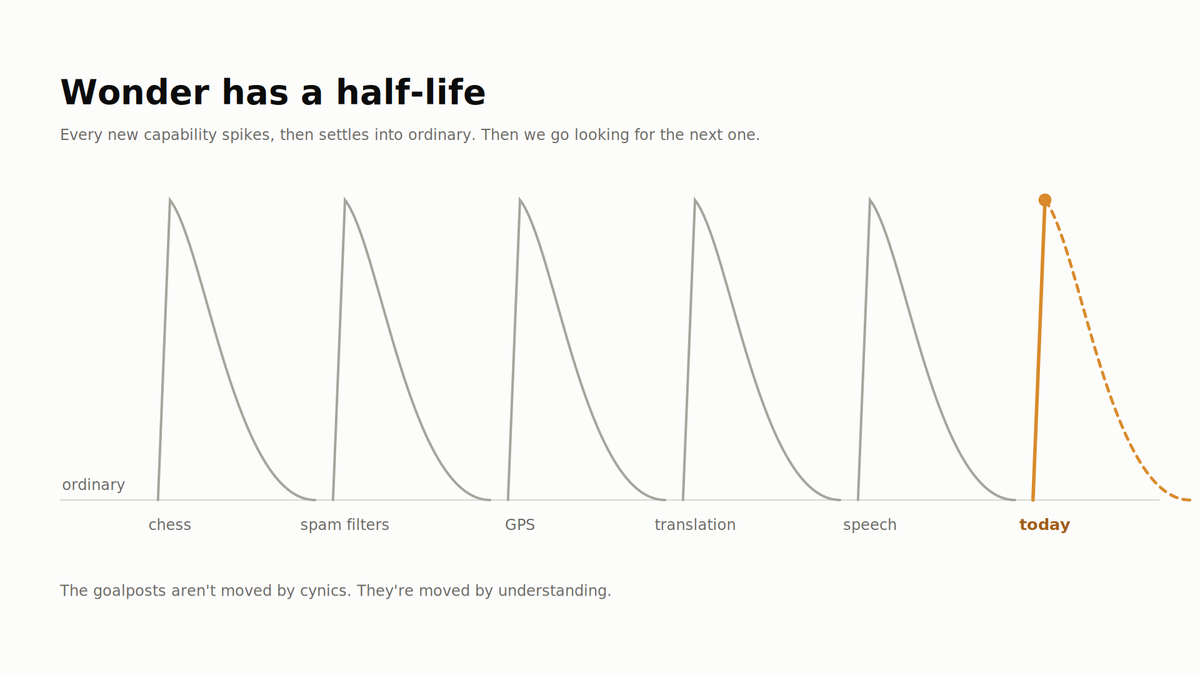
Wonder has a half-life
In 1979, Pamela McCorduck gave this pattern a name in her book Machines Who Think: the AI effect. The observation is that the moment a machine does something we called intelligent, we stop calling it intelligent.
Larry Tesler compressed it into a line that has outlived most of the software it described: "AI is whatever hasn't been done yet." John McCarthy — who coined the term "artificial intelligence" in the first place — put it even more bluntly: as soon as it works, nobody calls it AI anymore. Rodney Brooks described the same reflex from the inside: solve a piece of intelligence and the magic evaporates on contact, leaving behind something everyone shrugs at as mere computation.
Consider the graveyard.
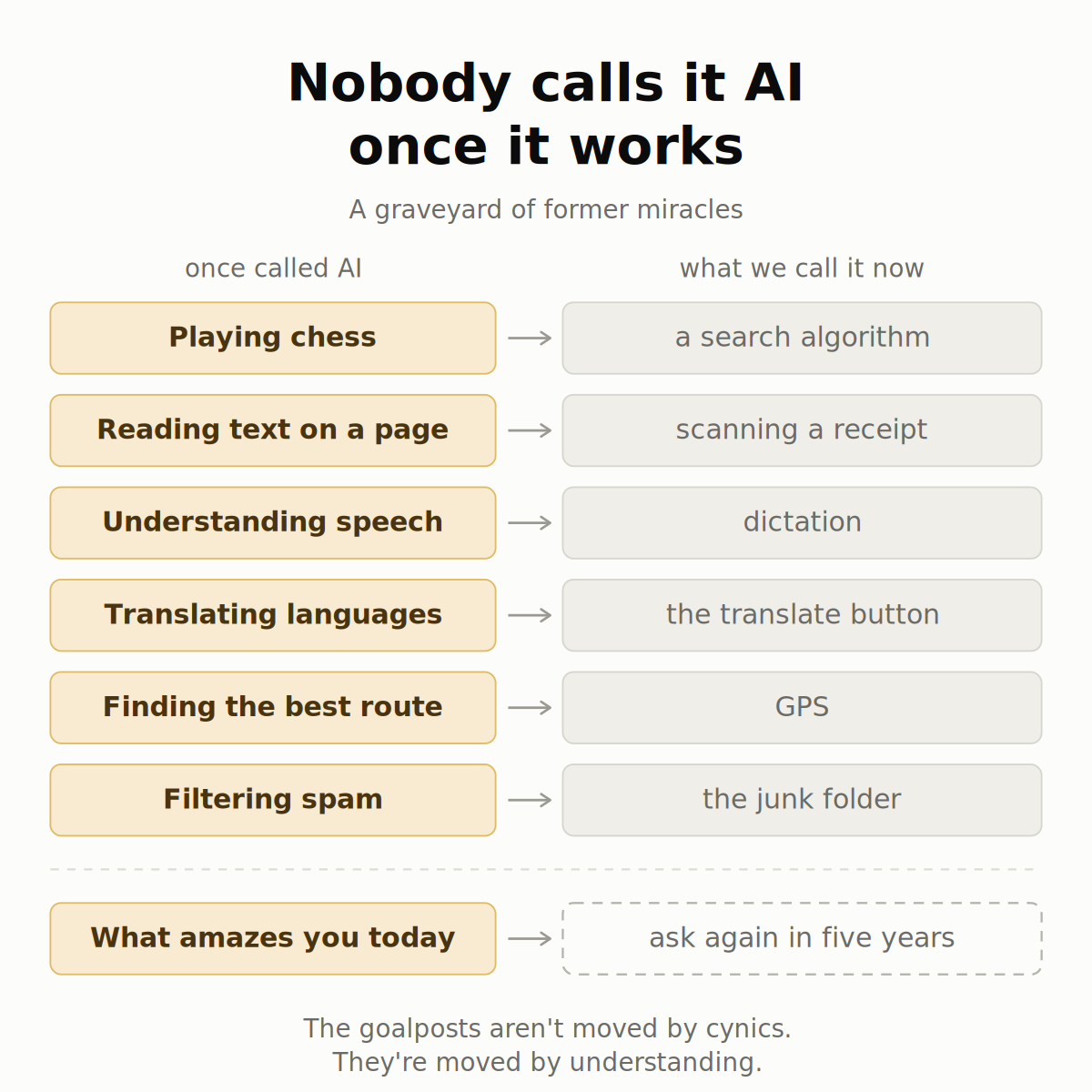
Chess was the benchmark for machine intelligence for forty years. Then Deep Blue beat Kasparov in 1997, and within a decade chess engines were a training tool — the way a batter uses a pitching machine. Optical character recognition was a landmark AI problem; now it's how you photograph a receipt. Speech recognition, machine translation, route-finding, spam filtering — every one of them was artificial intelligence right up until the moment it worked. Then it became a feature, and then it became furniture.
Here is the part worth sitting with: this is not ingratitude. It's not that people are spoiled or that the press moves on. It's something stranger and more human. Understanding is what kills the wonder. As long as a thing is opaque, it feels like intelligence. Once you can explain the mechanism, it becomes just the mechanism. We keep a protected category in our heads labeled "real intelligence," and we keep relocating it to whatever hasn't been explained yet.
Which means the goalposts were never going to stay still. They aren't being moved by cynics. They're being moved by comprehension.
Why the gains never feel like gains
There's a second force at work, and this one is older than computing.
In 1865, the economist William Stanley Jevons noticed something that should have been impossible. James Watt had made the steam engine dramatically more efficient — far less coal for the same work. Every sensible person expected coal consumption to fall. It rose. Sharply. Because cheap steam power was suddenly worth applying to things nobody would have bothered with before: textiles, shipping, mining deeper. Efficiency didn't shrink demand. It unlocked it.
We now call this the Jevons paradox, and it is the reason your productivity gains never seem to arrive as free time.
Ask yourself a specific question. Last week, AI probably saved you a few hours. What did you do with them?
Almost nobody answers "I rested." The saved hours went into more output — a deeper draft, a second option, three more variations, a thing you wouldn't have attempted before because it wasn't worth the effort. The work expanded to fill the new capacity, exactly as it always has. The spreadsheet didn't give accountants shorter days; it gave them models nobody could have built by hand and the expectation that they would build them. Word processors didn't reduce writing. They increased it.
So the recalibration isn't a bug in human psychology. It's the same mechanism that took us from one program a week to one deployment an hour. Capability rises, expectations rise to meet it, and the felt experience — the sensation of being slightly behind, of working at full stretch — stays roughly constant.
That's the honest answer to why AI doing more hasn't made anyone feel like they're doing less.
The displacement everyone predicted, and the one that showed up
This is where the comfortable version of the story usually ends, and where I want to be careful, because the comfortable version is incomplete.
The reassuring example is the ATM. When cash machines rolled out across American banks, the prediction was obvious: machines that dispense cash will replace the humans who dispense cash. The economist James Bessen documented what actually happened. Tellers per branch fell from about 21 to 13 — but that made branches so much cheaper to operate that banks opened far more of them. Urban branches grew roughly 43%. Total teller employment went up.
It's a great story. It's also usually told with the ending cut off. Teller employment did eventually decline — in the 2010s, when mobile banking arrived and automated not some of the teller's job but nearly all of it. The real lesson isn't that automation never costs jobs. It's narrower and more useful: partial automation expands demand, and only near-total automation contracts it.
There's a similar cautionary tale in medicine. In 2016, Geoffrey Hinton suggested we should stop training radiologists, because AI would make them obsolete within five years. Nearly a decade on, demand for radiology is at record highs. Better imaging analysis didn't reduce the need for imaging. It made imaging worth doing more often.
And in 2026, the data mostly supports the recalibration thesis — with one significant exception. For workers who already have a career, augmentation is winning: the job title stays and the work inside it changes. But entry-level hiring in AI-exposed fields is contracting, and every serious source agrees on this. Yale's Budget Lab found no clear rise in AI-task exposure among the unemployed, which suggests AI is suppressing new hiring more than it's firing existing staff. Overall unemployment has held near 4.3%.
That's not a jobs apocalypse. But it is a specific and real harm, and it lands on exactly the people with the least power to absorb it. The ladder still stands; someone has been quietly sawing off the bottom rungs. If you're established, the expectations treadmill is an interesting observation about human nature. If you're twenty-two, it's the reason you can't get the job that teaches you the thing.
Anyone writing the optimistic version of this essay — including me — owes you that caveat.
So what's next?
I'm not going to predict the hardware. Everyone does, everyone's wrong, and it isn't what this is about anyway.
What I'll predict is the feeling, because the feeling has been remarkably consistent for sixty years.
Whatever astonishes you this year becomes your baseline within about eighteen months, and your floor after that. The thing you currently describe to friends as "genuinely unbelievable" will, before long, be the thing you complain about when it's slow. You will not notice this happening. Nobody ever does — that's the whole point of the graveyard.
And the scarce resource keeps moving. In 1964 it was machine time; you rationed runs. In 2006 it was capital; you rationed servers. Today, with the marginal cost of producing something approaching zero, the scarce thing is judgment — knowing which of the thousand things you can now do are actually worth doing. When anyone can generate a hundred options in a minute, the constraint isn't generation. It's taste, and the willingness to throw ninety-nine of them away.
Which brings us back to that room in 1970.
The engineer watching a program run clean for the first time and the engineer watching an agent complete a task unsupervised are the same person, sixty years apart. Both did something that felt impossible. Both watched it become ordinary faster than they expected. And both, almost immediately, started looking for the next impossible thing.
That restlessness isn't a flaw in how we respond to technology.
It's the engine that produced all of it.