Stop Stuffing the Context Window: Why AI Coding Is Going Decoupled
Bigger context windows didn't fix AI coding agents. The real gains come from architecture: isolated subagent contexts, independent evaluators, decoupled tools.
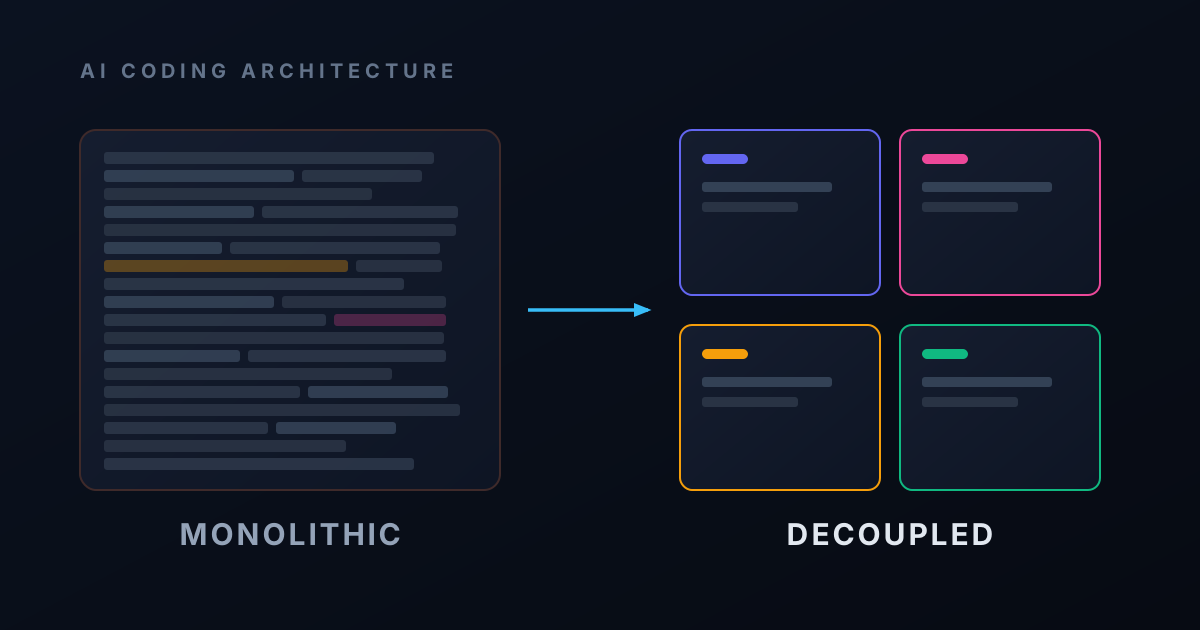
For the past two years, the AI coding meta has been defined by one brute-force arms race:
Who has the largest context window?
We celebrated 100K, 200K, and million-token windows under the assumption that if we could fit an entire codebase, five stack traces, and fifty pages of documentation into a single prompt, the model would produce better software.
But context capacity and context utilization are not the same thing.
As an agent accumulates file contents, diffs, tool output, build logs, and conversation history, the instructions and evidence that actually matter get harder to retrieve and prioritize. Research has documented one version of this problem as "Lost in the Middle": models perform measurably worse when the relevant information is buried inside a long context rather than positioned near its beginning or end. Long-running agent sessions add their own variant, where the noise accumulates turn over turn rather than arriving all at once.
The architectural response is the same in both cases.
Stop making one session carry everything.
Autonomous engineering is becoming less about raw token capacity and more about architectural decoupling.
That plays out in four places — context, evaluation, structure, and tooling:
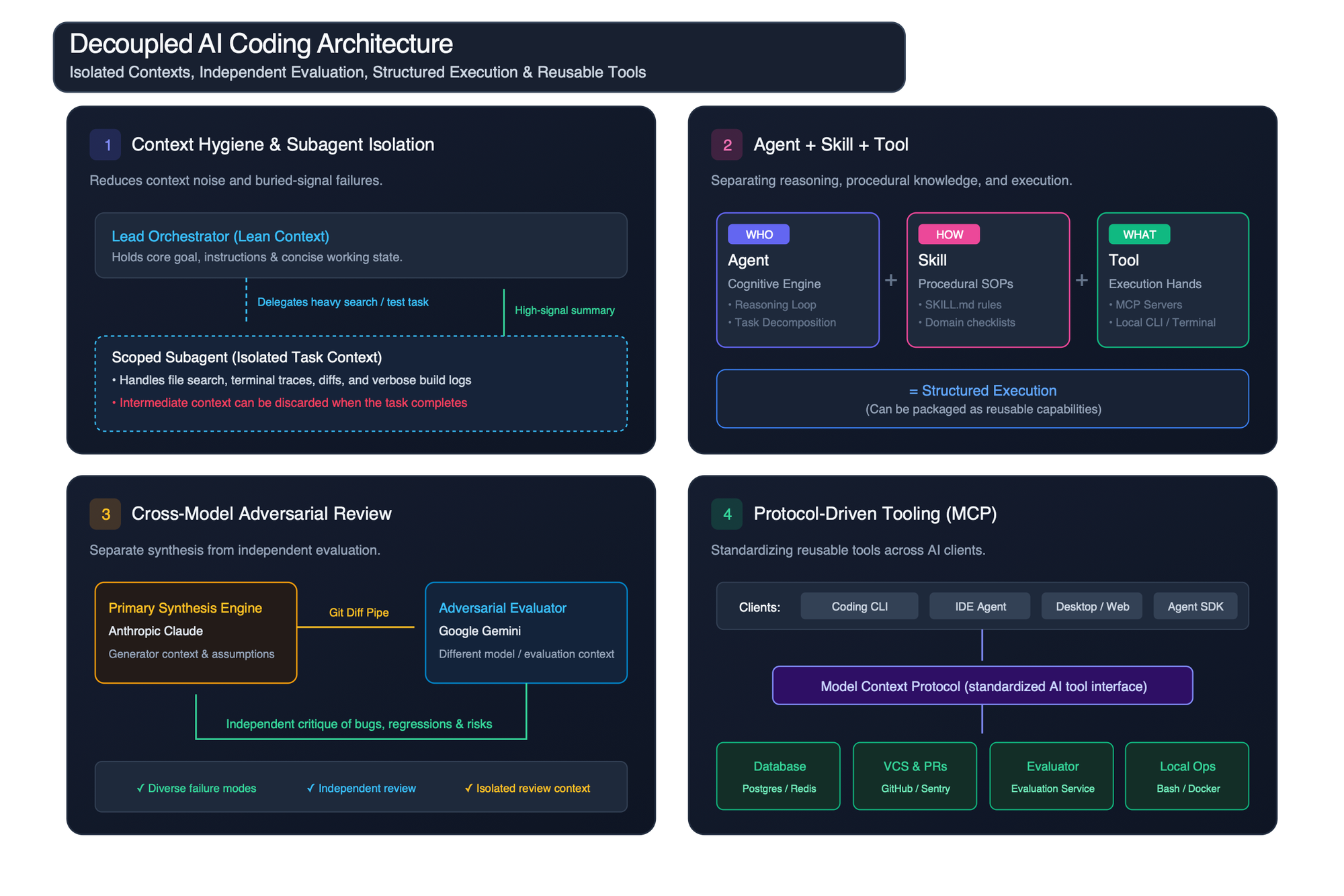
1. Context isolation: keep the orchestrator lean
Consider a coding agent that needs to search 40 files, inspect a large git diff, run a build, parse thousands of lines of terminal output, investigate a failing test, and then decide what to do next.
The naïve architecture puts all of that into one continuously growing session:
Monolithic loop:
[Instructions] + [File Diffs] + [Build Logs] + [Tool Output] ──► One Giant Context ──► Reasoning
The alternative is to separate coordination context from execution context:
Decoupled architecture:
[Orchestrator: Lean Context] ──► spawns ──► [Scoped Subagent: Isolated Context]
                                                     │
                                                     ▼ (runs the noisy work, discards the noise)
[Orchestrator] ◄────── High-Signal Result ───────────┘
The subagent absorbs the noisy work — grepping the tree, running the build, reading the diff — and returns only what the orchestrator needs to make its next decision. Everything else gets thrown away.
In Claude Code this is concrete rather than theoretical: subagents are defined as lightweight Markdown configurations under .claude/agents/, scoped to a task, and torn down when it completes. Other frameworks name it differently, but the shape recurs.
This is why subagents matter in coding systems, and it isn't that you now have more agents.
They are context boundaries.
A subagent can take on high-entropy work without forcing every intermediate artifact into the primary reasoning loop.
2. Self-review is not independent evaluation
There is a second problem with monolithic agent loops: the model that generated the solution is usually also the one asked to judge it.
Suppose the primary coding model makes a flawed architectural assumption. Then we ask it:
Review the code you just wrote for bugs.
Self-review catches real mistakes. Typos, obvious logic errors, forgotten edge cases — a second pass finds plenty of them.
But it is not independent evaluation. The generator and the reviewer share assumptions, reasoning patterns, and failure modes. The bug that came from a wrong premise is precisely the bug that a reviewer holding the same premise will read straight past.
A stronger architecture separates the two roles:
Homogeneous review:
Primary Model (writes code) ──► Same Model (reviews code) ──► "Looks good to me"

Heterogeneous adversarial review:
Primary Synthesis Engine ──► [git hook / subagent] ──► Adversarial Evaluator ──► Independent critique
In practice this can be as simple as piping a diff to a second model from a pre-commit hook, or exposing the evaluator as a subagent the orchestrator calls before it opens a PR.
Using a different model does not guarantee a better review. What it buys you is diversity of failure modes — a different training distribution, different priors, a different set of things it tends to miss.
And that is the part worth internalizing, because the model swap is the least interesting version of the idea. The goal isn't Claude versus Gemini. The goal is to avoid making generation and evaluation the same cognitive loop.
The pattern extends well past model choice. A reviewer can have different instructions, different tools, different context, different permissions, or different acceptance criteria — and still be a different model family on top of all that.
The principle is simple: decouple synthesis from evaluation.
3. Agent + Skill + Tool: separate reasoning, knowledge, and action
A third distinction is emerging in agent systems, and it maps cleanly onto the same instinct:
Agent + Skill + Tool = Structured Execution
Agent — cognition. The LLM-driven decision engine. It reasons, plans, chooses actions, and delegates work.
Skill — procedural knowledge. Reusable instructions that encode how your organization performs a task: code-review standards, deployment procedures, PR conventions, incident-response workflows, migration rules. Rather than re-injecting these into prompts every time, they become versioned context modules — SKILL.md files that live next to the code they describe.
Tool — execution. The capability that actually touches the outside world: shell commands, Git operations, databases, APIs, browsers, ticketing systems, cloud infrastructure.
Plugin — packaging. The distributable bundle that wraps agents, skills, and tools into a single installable capability.
The terminology isn't the point, and different vendors will name these differently. What matters is the separation:
reasoning → procedural knowledge → execution
When those three concerns are separated, each evolves independently. You can rewrite a review checklist without touching the agent. You can swap the underlying model without rewriting your deployment procedure. You can add a tool without renegotiating what the agent knows.
4. SDK vs. MCP: decouple tools when reuse matters
This leads to a question engineering teams keep running into:
If my Agent SDK can define tools directly, why do I need MCP?
Sometimes you don't.
Native SDK tools are the simpler choice when the tool belongs to one application, execution is in-process, latency matters, implementation and consumer share a runtime, and there is little value in exposing the capability elsewhere. A Python agent calling a Python function does not need a protocol layer to do it.
MCP becomes interesting when the tool should be independent of the agent consuming it. Think of it as a standardized integration layer between AI applications and external capabilities. Instead of embedding a database connector separately into every agent application, one MCP server exposes that capability through a common interface:
[Coding CLI]  [IDE Agent]  [Desktop Client]  [Internal Assistant]  [Agent SDK]
      └────────────┴──────────────┬──────────────┴──────────────────┘
                                  ▼
                      [Shared MCP Tool Server]
The benefit is not that MCP replaces REST or gRPC. It doesn't, and you shouldn't reach for it when two services need to talk to each other deterministically. The benefit is that an AI-facing capability gets exposed through a standardized tool interface instead of being welded to one agent implementation.
Use ordinary APIs for ordinary service-to-service calls. Use MCP when an LLM needs to discover, reason about, and invoke a capability at runtime — especially when more than one client will want it.
The bigger pattern
Look across all four and the same principle keeps surfacing.
Don't put all the context in one session. Don't put all the reasoning in one agent. Don't put generation and evaluation in the same cognitive loop. Don't weld every tool into one agent implementation.
Decouple them.
The interesting progress in AI coding isn't the next jump from a 200K window to a million-token window. It's what happens around the model: focused contexts, specialized workers, independent evaluators, reusable skills, decoupled tools.
The future of AI-assisted software engineering looks less like one giant model that knows everything, and more like a system of focused components that know what to do, what context they need, and when to hand the problem to something else.
The teams getting real work out of coding agents aren't the ones with the biggest budget for tokens. They're the ones who figured out which parts of the problem should never have been in the same room.